Product Feature: Hollow Braid Polypropylene Rope
Hollow braid polypropylene is a lightweight, coreless rope used across marine, barrier, landscaping, and general-purpose applications. It’s built to handle well, resist moisture and chemicals, and move in volume at a price point that makes sense for high-use, moderate-load work.
At Erin Rope Corporation, we manufacture hollow-braid polypropylene in diameters from 3/16” to 1/2” in ten colors. This guide covers the construction, material properties, performance limitations, typical applications, and how to position the product for your customers.
Hollow Braid Construction
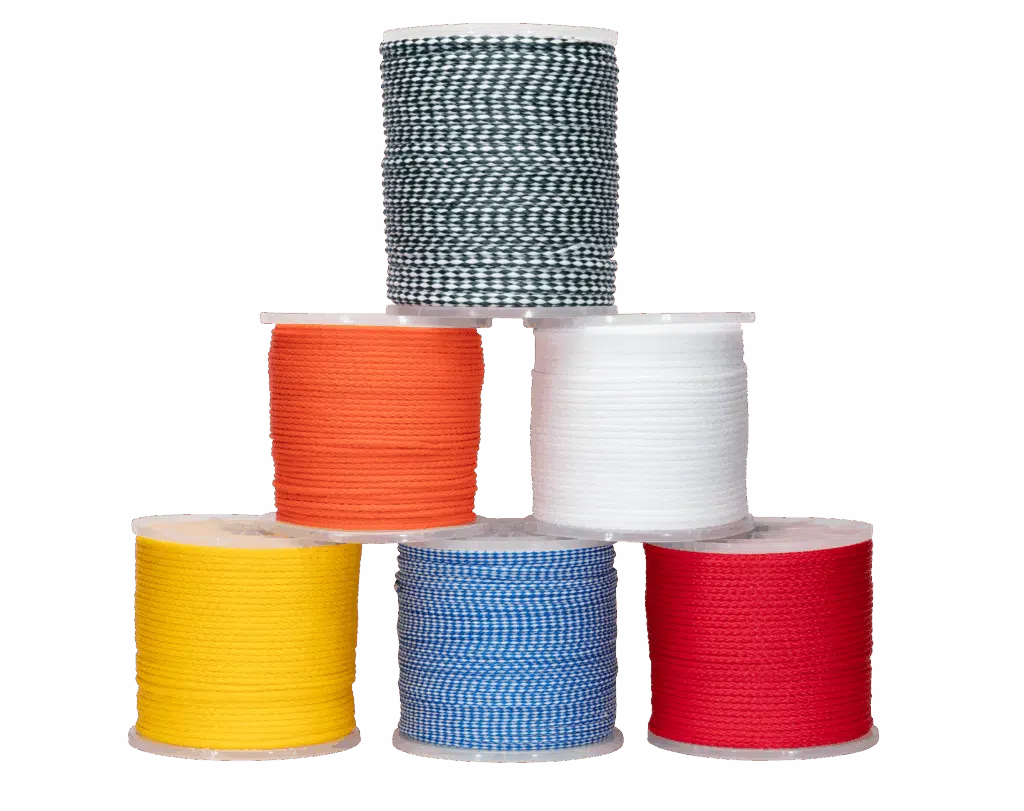
Hollow braid is an 8-strand braided construction with a hollow center and no internal core. The strands are interwoven in a diamond pattern, creating a tubular rope that lies flat when not under tension. This is sometimes referred to in the industry as an 8-strand diamond braid with a hollow center. The rope is structurally similar to a diamond braid, but without the parallel fiber core that provides additional tensile strength in cored constructions.
Performance & Strength Considerations
The coreless design has direct implications for the rope’s performance. Without a core, a hollow braid is lighter per foot, more flexible, and significantly easier to splice than a cored rope.
Hollow braid does not require any specialized tooling for splicing or cutting. Eye splices can be completed in minutes using a fid or even a screwdriver to spread the braid. The hollow construction works like a finger trap: the more tension applied, the tighter the splice holds. A properly executed eye splice provides maximum strength retention and should yield the rope’s minimum breaking strength. That’s a meaningful advantage over knots, which can reduce rope strength by up to 50%.
The tradeoff is tensile strength. Without a load-bearing core, hollow braid has lower break strength at the same diameter compared to diamond braid, double braid, or 3-strand constructions. That’s an acceptable tradeoff for the applications this rope is designed for, but it should not be specified for heavy-load, overhead lifting, or life-safety applications.
How Hollow Braid Compares
| Construction | Strength | Flexibility | Best For |
| Hollow Braid | Moderate | Very High | Barrier, marine, landscaping, general purpose |
| Diamond Braid (8-Carrier) | Moderate | High | General purpose, tie-downs, marine, utility |
| 3-Strand Twisted | High | Moderate | Towing, mooring, lifting |
| Double Braid | Very High | High | Heavy pulling, cable installation |
| Solid Braid | Moderate–High | Moderate | Flagpole, pulleys, blocks |
Hollow braid is the lightest and most flexible construction in the lineup. It’s also the easiest to splice. Where it gives ground is in raw break strength. It’s not a pulling rope, nor is it a rigging rope.
Material Properties: Polypropylene
Understanding the fiber is just as important as understanding the construction. Polypropylene has a specific gravity of 0.91, which makes it the lightest common synthetic rope fiber and the reason it floats in both fresh and salt water. Here’s what that means in practice:
Buoyancy
Polypropylene is one of the only synthetic rope fibers that floats. The coreless hollow braid construction amplifies that advantage. The rope stays on the water’s surface, making it easy to retrieve and visually track in marine and barrier applications.
Moisture Resistance
Polypropylene absorbs virtually no water. It can be stored wet or dry without degrading, and it will not rot, mildew, or swell after prolonged exposure to moisture. This makes it a reliable choice for any application involving sustained contact with water.
Chemical Resistance
Polypropylene has good resistance to most non-oxidizing acids, alkalis, petroleum products, oils, gasoline, and common industrial chemicals. It is not recommended for use with strong oxidizing agents, chlorinated hydrocarbons, or aromatic solvents.
UV Resistance
Polypropylene has moderate UV resistance compared to polyester or nylon. Our hollow braid is manufactured with UV-stabilized fibers to extend outdoor service life, but prolonged, unprotected exposure to direct sunlight will degrade the fiber over time. If the rope is to be permanently installed outdoors, inspect it regularly for signs of discoloration, surface splintering, or fiber brittleness.
Temperature Considerations
Polypropylene has a relatively low melting point of approximately 320°F (160°C). Rope tensile strength decreases at elevated temperatures and continues to decline significantly above 180°F. Polypropylene rope should not be used where friction-generated heat is a concern. At the other end of the spectrum, polypropylene can become brittle below 0°C (32°F), which is worth considering for cold-weather applications.
Stretch
Polypropylene has low to moderate elongation—similar to polyester in extension to break —but with lower tensile strength. It does not offer the shock-absorbing elasticity of nylon. For applications requiring energy absorption under dynamic loads, nylon is the preferred fiber.
Performance Advantages
Lightweight Handling
Without an internal core, hollow braid polypropylene is significantly lighter per foot than comparable cored ropes. That translates to less crew fatigue over the course of a shift, faster deployment, and easier coiling and storage.
Field Splicing
The tubular, coreless construction makes hollow braid one of the simplest rope types to splice on site. A splice can be completed in minutes with a fid. For crews building their own assemblies or adjusting rope lengths in the field, this is a significant time and labor advantage.
Knot Holding
The diamond weave pattern provides reliable knot holding. That said, splicing is always the preferred termination method. Where a permanent eye or loop is needed, splice it.
Economy
Hollow braid polypropylene is one of the lowest-cost rope constructions on the market. For applications that consume rope in volume, the price point makes it practical to stock and deploy at scale.
Common Applications
- Swimming pool and beach barrier lines
- Dock lines and light-duty boat mooring
- Landscaping and property delineation
- Tarp, cover, and lightweight load securing
- Flagging, crowd control, and event perimeters
- Crab pots, lobster traps, and recreational fishing
- Camping and tent guy lines
- General-purpose securing and bundling
Color availability matters for many of these applications. We offer hollow braid in white, yellow, black, blue/white, hunter green, hunter green/white, kelly green, kelly green/white, international orange, and red. High-visibility orange and yellow serve safety and marking applications. Green blends into landscaping. Black works for low-profile installations.
Specs at a Glance
Tensile strengths listed below are determined from tests on new, unused rope in accordance with standard test methods.
| Diameter | Min. Break Strength | Density (lbs./100 ft.) | Available Lengths |
| 3/16″ | 450 lbs. | 0.6 | 1,000 ft. / 3,000 ft. |
| 1/4″ | 1,000 lbs. | 0.9 | 500 / 1,000 / 3,000 ft. |
| 5/16″ | 1,400 lbs. | 1.4 | 1,000 ft. |
| 3/8″ | 2,000 lbs. | 1.9 | 500 ft. / 1,000 ft. |
| 1/2″ | 2,600 lbs. | 3.2 | 500 ft. / 1,000 ft. |
Full part numbers, color availability by diameter, and packaging details are available on our product page and downloadable cut sheet. Contact us directly for custom lengths or colors.
Important: Hollow braid polypropylene rope is not rated for overhead lifting, support of human weight, or life-safety applications. Working loads should never be exceeded, and shock loading can reduce effective working capacity by a third or more. Always inspect the rope before use and retire any rope showing signs of wear, UV degradation, or fiber damage.
How to Sell Hollow Braid
Know the boundary
Hollow braid is the right choice for lightweight, general-purpose work where ease of handling, buoyancy, and economy are the deciding factors. If the customer needs high tensile strength, low stretch under load, or heavy-duty pulling performance, move them to diamond braid, double braid, or 3-strand.
Lead with the color range
Many buyers default to white or yellow without realizing the full selection. For landscaping, property management, marine, and safety applications, color is a functional specification. We recommend stocking a wide range of colors to meet your customers’ varying application needs.
Sell the splice advantage
Customers who build their own assemblies or adjust rope lengths on site will immediately see the value of a coreless construction that splices in minutes with basic tooling. This is a real differentiator versus cored ropes that require more time, technique, and often specialized tooling to splice properly.
Offer it alongside diamond braid
Hollow braid and diamond braid serve overlapping markets but at different performance and price levels. When a customer doesn’t need the added strength of cored construction, hollow braid offers a lighter, more flexible, and more affordable option. Carrying both lets you right-size the recommendation and demonstrate product knowledge.
Browse the full Hollow Braid Polypropylene lineup at erinrope.com/constructions/hollow-braid-rope, or call us at 708-377-1084 for product guidance and cut sheets.