A Complete Guide to Cable Hardware
Cable hardware is where wire rope assemblies succeed or fail. You can specify the right rope for the load, environment, and application, and still end up with an underperforming or unsafe assembly if the hardware is wrong. Yet hardware selection often gets less attention than rope selection in the procurement process.
This guide covers the five cable hardware components we stock at Erin Rope — wire rope thimbles, wire rope clips, aluminum cable sleeves, machinery eye bolts, and turnbuckles — with a focus on selection, configuration decisions, and other field considerations for reliable assembly.
Wire Rope Thimbles: Protecting the Eye Under Load
Wire Rope Thimbles: What They Do
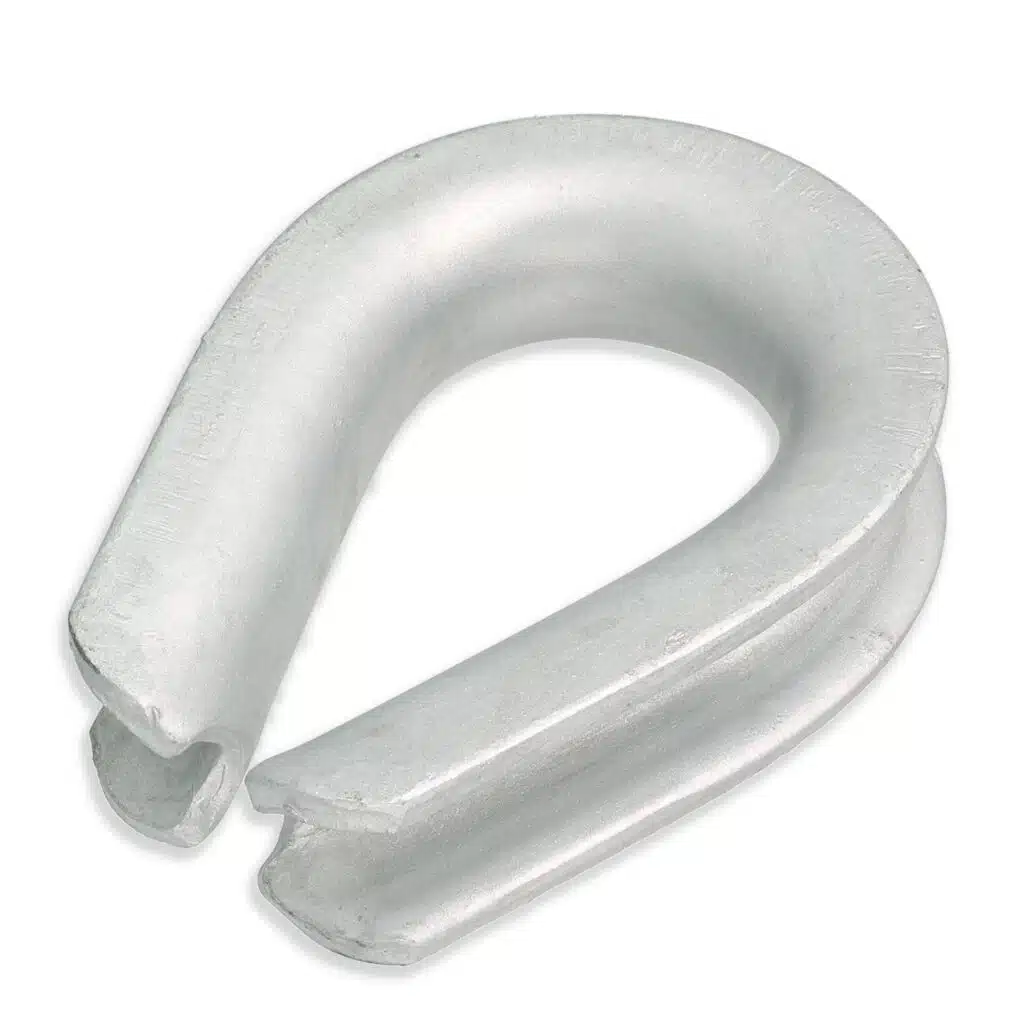
Wire rope thimbles reinforce the eye of a wire rope loop, maintaining the correct bend radius and protecting the rope from concentrated stress at the point where it meets a shackle, hook, or fitting. Without a thimble, a wire rope eye degrades rapidly under load. This includes the rope bending too tightly, fiber fatigue at the contact point, and the assembly’s rated strength not being maintained.
Standard Duty vs. Heavy Duty
Erin Rope carries both standard and heavy-duty thimbles, manufactured to Federal Spec FF-T-276b, Type III, in sizes 1/8″ through 3/8″.
Standard duty covers the majority of rigging, anchoring, and guying applications. Heavy-duty is the right choice when the assembly will experience high cyclic loading, elevated sustained tension, or conditions where groove deformation could affect the fit of the eye seats in a fitting.
The Specification Detail That Often Gets Missed
Thimble diameter and D/d ratio are not the same consideration. A thimble can match the rope diameter while still forcing a bend tighter than the wire rope manufacturer’s minimum bend radius allows. Before finalizing hardware specs, confirm that the selected thimble accommodates the rope’s minimum D/d requirement. It is a simple verification that eliminates a common source of premature assembly wear.
Wire Rope Clips: Choosing the Right Grade
Wire Rope Clips: Drop-Forged vs. Malleable
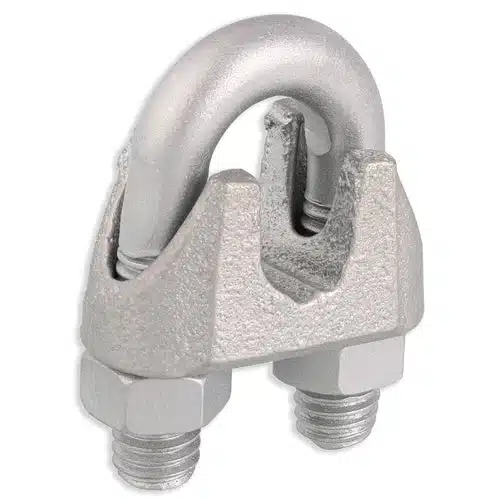
Wire rope clips are available in two constructions. Both are available in sizes 1/16″ through 3/8″.
- Galvanized drop-forged (Federal Spec FF-C-450D Type 1, Class 1) — the correct choice for load-bearing applications. Higher strength, tighter dimensional tolerances, and a federal spec that reflects the performance difference.
- Zinc-plated malleable (Federal Spec FF-C-450D Type 1, Class 2) — appropriate for light securing and non-critical applications.
Two Installation Failures That Compromise Assembly Integrity
Reversed saddle orientation. The saddle bears on the live (load-bearing) end of the rope; the U-bolt bears on the dead end. This is widely known and still routinely done wrong. A reversed clip assembly can lose 40% or more of its rated connection strength.
Skipping post-load re-torquing. Clips seat and compress under initial loading. Retorquing to the specified torque value after the assembly is first loaded is a required step, not a precaution. Assemblies that skip this step will back off under vibration and cyclic loading.
Aluminum Cable Sleeves: When Permanent Termination Is the Right Call
How Sleeves Differ from Clips
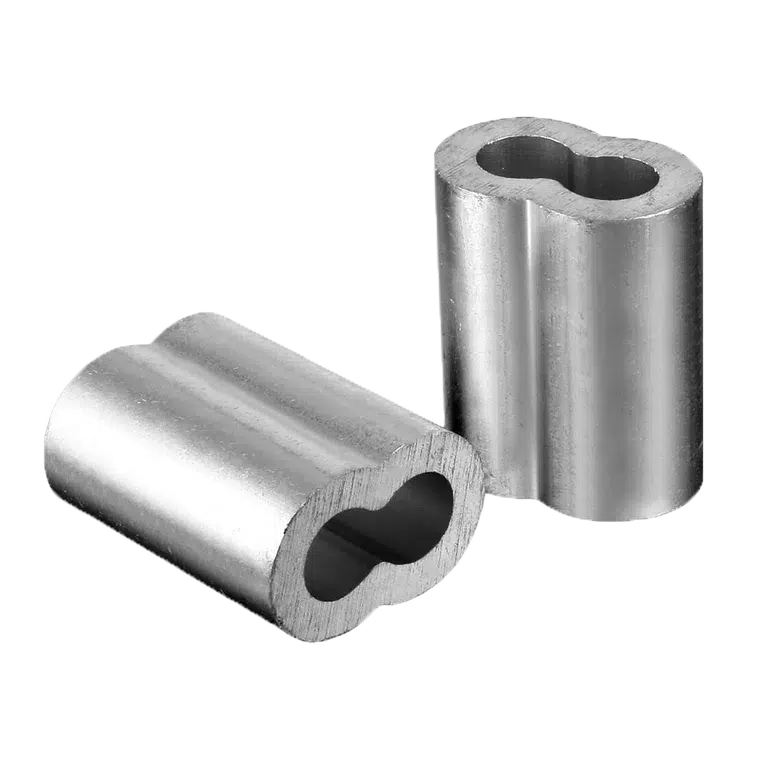
Where wire rope clips form a mechanical clamp, aluminum cable sleeves are threaded over the rope ends and swaged with a crimping tool to create a permanent, high-strength termination. A properly swaged sleeve achieves full line strength and produces a lower profile than a clipped connection — an important consideration when the terminated end must clear a fitting or seat flush against a surface.
Sizes range from 1/16″ through 1/2″, available in packages of 100 and cartons of 1,000.
When to Choose Sleeves vs. Clips
The core trade-off is between permanence and adjustability.
Sleeves are the right choice for production assembly work, pre-built wire rope slings, and installations where the termination is set once and not revisited. For applications that require periodic disassembly, field adjustment, or inspection that involves breaking the connection, wire rope clips provide the flexibility that sleeves cannot.
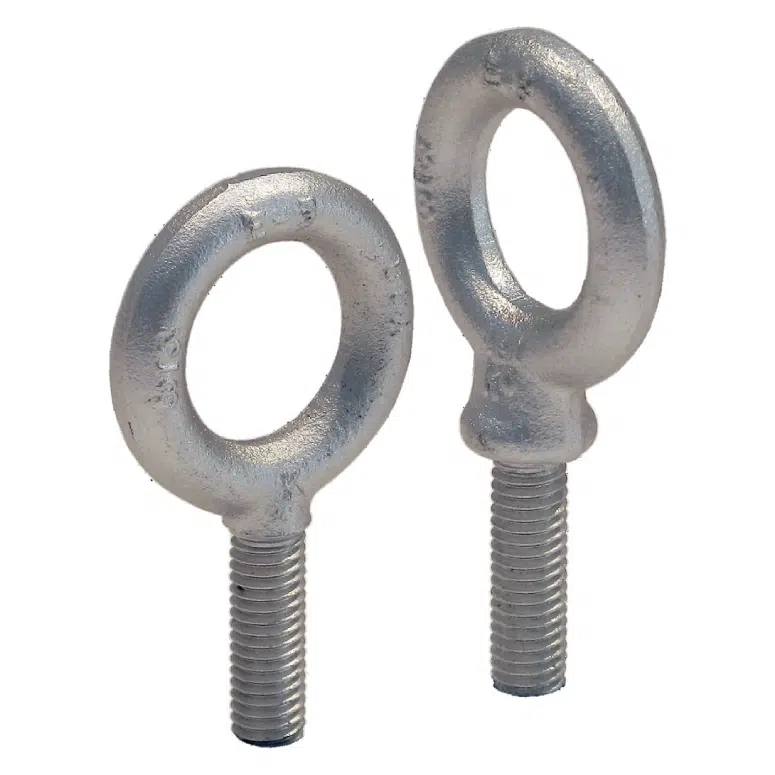
Machinery Eye Bolts: The Angular Loading Decision
Machinery Eye Bolts: Shoulder Pattern vs. Plain Pattern
This is the specification decision that carries the greatest safety implications in the hardware category.
Plain pattern eye bolts are rated for axial (inline) loading only. Angular loading on a plain pattern bolt reduces the working load limit (WLL) significantly and introduces bending stress into the shank in a manner that the design does not accommodate. For any application where the load direction cannot be guaranteed to remain perfectly inline, the shoulder pattern is the correct specification.
Shoulder pattern eye bolts transfer angular load components into the work surface through the seated shoulder, rather than concentrating them in the shank. Both patterns are available in sizes 1/4″ x 1″ through 1-1/2″ x 3-1/2″, with WLL ranging from 500 lbs. to 19,600 lbs.
Angular Load Derating
Even shoulder pattern eye bolts lose rated capacity as the load angle increases. At 45°, WLL can drop 30% or more. Specifying based on the vertical WLL without accounting for the actual load angle is one of the more common sources of overloading in lifting and rigging applications.
Turnbuckles: Configuration, Tension Control, and In-Service Maintenance
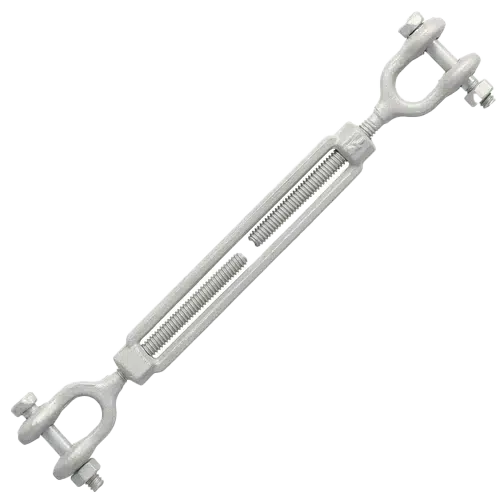
What Turnbuckles Do That Other Hardware Cannot
Turnbuckles provide adjustable tension in a wire rope, rod, or cable assembly. They allow precise tension to be set after installation and readjusted over time without cutting or re-terminating the assembly. For guy wire installations, structural bracing, antenna and tower work, and marine rigging, that adjustability is not a convenience — it is a functional requirement.
Erin Rope carries hot-dip galvanized turnbuckles in three end configurations, sizes 1/4″ through 3/4″, with WLL up to 5,200 lbs. depending on configuration.
Choosing the Right End Configuration
| Configuration | Best For |
|---|---|
| Eye & Eye | Permanent installations with fixed hardware at both ends |
| Eye & Hook | Applications requiring periodic disconnection at one end |
| Jaw & Jaw | Pinned connections to fixed anchor points; resists rotation |
In-Service Requirements
Equal thread engagement. Both ends should be threaded equally to maintain axial loading through the body. Unequal threading introduces off-center loading, accelerating thread wear, and reducing the effective WLL of the assembly.
Locking after tensioning. In any application subject to vibration or cyclic loading, the turnbuckle body must be secured with a jam nut or safety wire after tension is set. Turnbuckles will back off under cyclic loading without a positive locking mechanism.
Seasonal thread inspection for outdoor and marine applications. Hot-dip galvanizing provides reliable corrosion protection across the body, but threads are the first areas where coating wear during adjustment exposes them to corrosion. Regular inspection is standard practice for extending service life.
Choosing the Right Hardware for Your Jobsite
Every wire rope assembly is only as strong as its weakest component. The right rope paired with the wrong clip grade, an undersized thimble, or a plain pattern eye bolt on an angled lift can compromise the integrity of your entire assembly.
The good news is that most of these calls are straightforward once you know what to look for. When they’re not, we’re here to help.
Erin Rope has been supplying cable hardware and wire rope products to industrial, construction, marine, and utility customers since 1998. If you’re specifying hardware for an upcoming project or just want a second set of eyes on a build, give us a call.
Contact our team today at 708-377-1084 | erinrope.com/contact