Product Feature: Double Braid Nylon Rope
Double braid nylon rope is a premium braided rope designed for demanding industrial and marine applications. It combines nylon’s high tensile strength and elasticity with a braided core and cover that provide a smooth surface and abrasion protection.
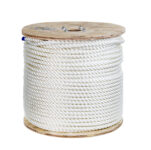
This construction makes double braid nylon a strong option for towing, load securement, general-purpose rigging, and marine lines that benefit from shock absorption. Erin Rope Corporation stocks double braid nylon in diameters from 1/4 inch to 1-1/2 inches, with continuous reel lengths of 600 and 1,200 feet.
This guide covers how double braid nylon is constructed, its key material properties, common applications, and how it compares with other rope options.
Double Braid Nylon Construction
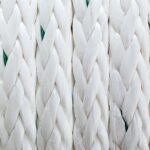
Double braid rope consists of a braided core surrounded by a braided cover. Erin Rope’s version uses a 24-carrier construction, with 24 yarn carriers interlacing to create a tight, round braid.
The core and cover share the load, giving double braid nylon a construction that can deliver greater strength per diameter than comparable 3-strand nylon rope.
Key Construction Benefits
Torque-free handling
The balanced braided construction resists twisting and unlaying under load. This helps prevent unwanted rotation and reduces the kinking and hockling associated with twisted rope.
Firm, round profile
Double braid nylon maintains its shape over sheaves, through blocks, and around capstans. The outer cover helps protect the load-bearing core from surface abrasion.
Smooth handling
The braided surface provides a comfortable hand in wet and dry conditions, making the rope easier to handle during repeated tying, adjustment, and general use.
Continuous reel lengths
Erin Rope supplies continuous lengths without factory splices along the reel. This gives crews flexibility when cutting rope to the lengths required for a particular job.
Spliceable construction
Double-braid nylon accepts a standard double-braid eye splice using appropriate splicing tools, including a fid and pusher. Splicing requires more steps than 3-strand rope, but a properly executed splice can retain most of the rope’s rated strength.
Nylon Rope Material Properties
Nylon’s strength and elasticity make it well suited to applications involving changing loads. Understanding how it responds to water, heat, and environmental exposure helps determine where it performs best.
Strength
Nylon offers high tensile strength relative to its weight. Erin Rope’s double braid nylon ranges from a minimum breaking strength of 1,900 lb. for 1/4-inch rope to 74,000 lb. for 1-1/2-inch rope.
These figures represent minimum breaking strength, not allowable working loads. The appropriate working load depends on the application, design factor, rope condition, and terminations.
Stretch and Shock Absorption
Nylon is more elastic than common synthetic rope fibers such as polyester. When a load surges, shifts, or jerks against the line, the rope stretches and absorbs some energy.
This can reduce peak forces transferred to anchor points, hardware, and connected equipment. This benefit is especially relevant for towing, mooring, and other dynamic-load applications.
However, stretch also stores energy. If a loaded nylon line or connection fails, the resulting snapback can cause serious injury. Keep personnel clear of the line of pull and follow appropriate operating procedures.
Water Absorption and Buoyancy
Nylon has a specific gravity of approximately 1.14, so it sinks in both fresh and salt water. This can be useful for marine applications where a submerged line is preferred.
Nylon also absorbs water and typically loses about 10% to 15% of its dry strength when wet. Strength generally recovers as the rope dries. Account for wet-service conditions when selecting rope and establishing working loads.
UV, Rot, and Mildew Resistance
As a synthetic fiber, nylon resists rot and does not deteriorate through biological decay the same way natural-fiber rope does. It also has better UV resistance than polypropylene. Prolonged sunlight can still degrade nylon fibers over time, so proper storage and regular inspection remain important.
Chemical Resistance
Nylon generally tolerates oils, alkalis, and many common solvents. Strong acids can attack the fiber, so avoid exposure to battery acid and incompatible acidic cleaners. When chemical exposure is possible, verify compatibility with the rope manufacturer before use.
Temperature and Friction Heat
Nylon has a higher melting point than polypropylene, but heat can damage the rope well before the fiber reaches its melting point.
Friction is a particular concern. A line slipping over a capstan, winch drum, or fixed post can develop glazed or fused fibers, reducing its strength. Inspect high-contact areas regularly and use suitable equipment and handling procedures to limit friction damage.
Double Braid Nylon vs. Other Rope Constructions
| Rope construction | Strength | Stretch | Buoyancy | Common applications |
|---|---|---|---|---|
| Double braid nylon | High | High | Sinks | Towing, load securement, suitable dynamic-load rigging and mooring |
| 3-strand nylon | High | High | Sinks | General utility, towing and anchor lines |
| Composite double braid polyester | High | Low | Sinks | Cable pulling, winch lines and applications requiring lower stretch |
| 3-strand polypropylene | Moderate | Moderate | Floats | Swim lanes, barrier lines, and general utility |
Two questions can help narrow your options.
Does the application benefit from stretch? Nylon’s elasticity can help absorb sudden forces. For cable pulling and other applications where controlling elongation matters, composite double-braid polyester may be a better fit.
How will the rope be handled? 3-strand nylon offers similar fiber properties and can be spliced with basic tools. Double braid provides a round, torque-resistant construction, with a braided cover that protects the core from abrasion.
Common Applications for Double Braid Nylon
Double braid nylon is used in a range of marine and industrial applications where its strength, elasticity, and handling characteristics are beneficial.
- Towing and vehicle recovery: Suitable nylon lines can absorb energy as loads change, provided the equipment is specifically rated for the recovery application.
- Load securement: Nylon’s elasticity accommodates some movement in appropriate securing systems. Always follow the applicable working load limits.
- General-purpose rigging and hauling: Useful where the rope’s strength and stretch suit the task and the equipment is properly rated.
- Block-and-tackle systems: Its round profile and smooth surface support movement through compatible blocks and sheaves.
- Dock, anchor and mooring lines: Stretch helps absorb movement caused by waves, wakes and wind.
- Military and government applications: The product conforms to Federal Specification MIL-R-24050, as specified for this rope.
Application suitability depends on the complete system, including hardware, terminations, expected loads, and applicable safety requirements.
Double Braid Nylon Rope Specifications
Erin Rope offers double braid nylon in diameters from 1/4 inch to 1-1/2 inches. The table below lists available part numbers, minimum breaking strengths, reel lengths, and package weights.
| Part number | Diameter | Reel length | Min. breaking strength | Weight per 100 ft. | Package weight |
|---|---|---|---|---|---|
| DBN080600 | 1/4 in | 600 ft | 1,900 lb | 1.7 lb | 10.2 lb |
| DBN081200 | 1/4 in | 1,200 ft | 1,900 lb | 1.7 lb | 20.4 lb |
| DBN120600 | 3/8 in | 600 ft | 4,200 lb | 3.7 lb | 23.0 lb |
| DBN121200 | 3/8 in | 1,200 ft | 4,200 lb | 3.7 lb | 46.0 lb |
| DBN160600 | 1/2 in | 600 ft | 7,400 lb | 6.6 lb | 40.0 lb |
| DBN161200 | 1/2 in | 1,200 ft | 7,400 lb | 6.6 lb | 80.0 lb |
| DBN200600 | 5/8 in | 600 ft | 14,800 lb | 11.6 lb | 69.6 lb |
| DBN201200 | 5/8 in | 1,200 ft | 14,800 lb | 11.6 lb | 139.2 lb |
| DBN240600 | 3/4 in | 600 ft | 19,000 lb | 14.7 lb | 88.2 lb |
| DBN241200 | 3/4 in | 1,200 ft | 19,000 lb | 14.7 lb | 176.4 lb |
| DBN320600 | 1 in | 600 ft | 33,600 lb | 26.0 lb | 156.0 lb |
| DBN321200 | 1 in | 1,200 ft | 33,600 lb | 26.0 lb | 312.0 lb |
| DBN330600 | 1-1/8 in | 600 ft | 45,000 lb | 35.4 lb | 213.0 lb |
| DBN331200 | 1-1/8 in | 1,200 ft | 45,000 lb | 35.4 lb | 426.0 lb |
| DBN340600 | 1-1/4 in | 600 ft | 52,000 lb | 40.7 lb | 245.0 lb |
| DBN341200 | 1-1/4 in | 1,200 ft | 52,000 lb | 40.7 lb | 488.0 lb |
| DBN360600 | 1-1/2 in | 600 ft | 74,000 lb | 58.4 lb | 351.0 lb |
| DBN361200 | 1-1/2 in | 1,200 ft | 74,000 lb | 58.4 lb | 702.0 lb |
Find full part numbers, packaging information, and the downloadable cut sheet on the Double Braid Nylon product page. Contact Erin Rope for custom lengths or product guidance.
Important: Minimum breaking strength applies to new, unused rope and is not a working load rating. Wet nylon typically has lower strength than dry nylon. Never exceed the applicable working load, and account for terminations, dynamic loading, and environmental conditions when sizing a rope system.
Nylon rope can store significant energy under tension and recoil violently if it or a connection fails. Keep personnel clear of loaded lines. Do not use this rope for overhead lifting, supporting human weight, or life-safety applications unless the specific product and complete system are expressly rated and approved for that use.
Double Braid Nylon Rope Inspection and Service Life
Abrasion and friction heat commonly damage double braid nylon. Areas that repeatedly contact edges, sheaves, and fixed hardware can wear faster than the rest of the rope.
Use suitable chafe protection at contact points where appropriate, and inspect the rope regularly for these warning signs:
- Worn or cut cover yarns: Look for excessive abrasion or areas where the core becomes visible.
- Glazed, hard, or fused fibers: These may indicate friction heat or melting.
- Flat spots or lumps: Shape changes can indicate crushing or internal damage.
- A cover that bunches or slides over the core: This may signal structural damage.
- Stiffness or discoloration: These changes can indicate heat or chemical exposure.
After exposure to grit, mud, or saltwater, rinse the rope with fresh water when appropriate and allow it to dry fully. Store it in a cool, dry location away from direct sunlight, excessive heat, and chemicals.
Remove damaged rope from service and follow the manufacturer’s inspection and retirement guidance. For a more detailed evaluation framework, see our Rope Inspection and Retirement Guidelines.
Find the Right Double Braid Nylon Rope
Double braid nylon combines high tensile strength, elasticity, and torque-resistant handling in a durable braided construction. It’s an ideal choice for industrial and marine applications where shock absorption is critical.
Erin Rope offers diameters from 1/4 inch to 1-1/2 inches in continuous 600- and 1,200-foot reels. Browse the full double braid nylon rope lineup for product specifications, part numbers, and cut sheets.
For help selecting a diameter, finding a custom length, or confirming product suitability, contact Erin Rope Corporation at 708-377-1084.